
6 min read · Last updated October 16, 2026
- The Hospital Readmissions Reduction Program penalizes hospitals, not patients: a hospital with too many Medicare readmissions within 30 days for 6 tracked conditions can lose up to 3 percent of its payments, under the Code of Federal Regulations (CFR) at 42 CFR § 412.154.
- Medicare’s Part A deductible, $1,736 in 2026, resets only after 60 consecutive days with no inpatient care, a separate clock from the 30-day readmission measure, under 42 CFR § 409.60.
- A readmission 12 days after discharge is almost always inside the same benefit period as the first stay, so no new deductible usually applies.
- You keep the same discharge-appeal rights on every inpatient stay, including a readmission, with written notice required within 2 calendar days of admission under 42 CFR § 405.1205.
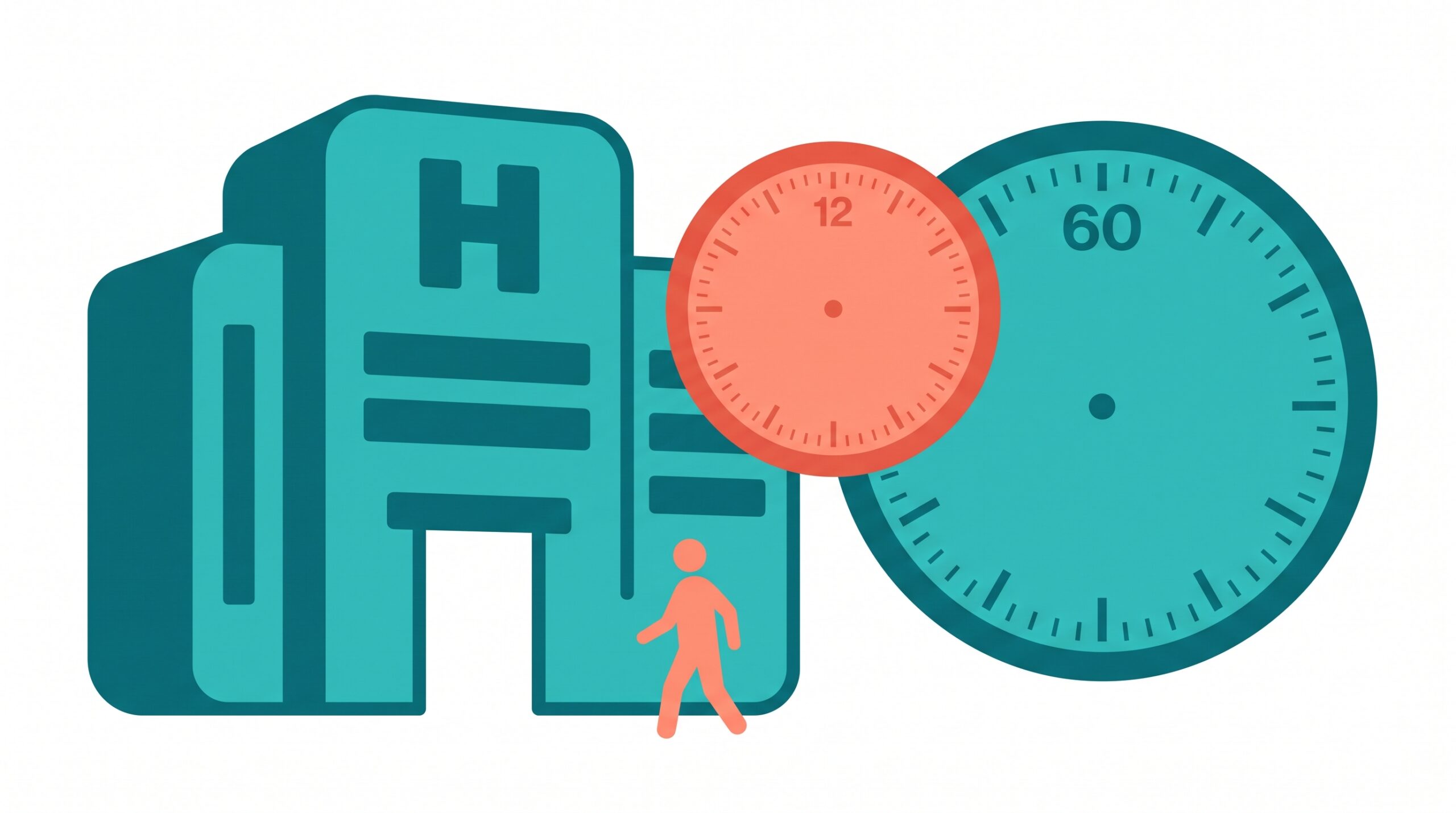
A Medicare patient readmitted within 30 days of hospital discharge faces a financial penalty aimed at the hospital, not a new deductible for themselves in most cases. That’s because the 30-day readmission measure and the 60-day benefit-period deductible rule are two different clocks.
In this article
- How Medicare Readmission Rules Affect Your Hospital Coverage
- What the Hospital Readmissions Reduction Program Actually Penalizes
- Why Walter Likely Owes No New Deductible
- What to Do in the First Hours of a Second Admission
- Frequently asked questions
A hospital readmission within 30 days of discharge does not usually cost you a new Medicare deductible or threaten your hospital coverage. The 30-day readmission penalty you may have heard about is a reimbursement cut on the hospital, under a different rule than the one deciding your own bill.
Say Walter is discharged after a hospital stay for heart failure, then readmitted 12 days later with the same symptoms. His daughter assumes Medicare might balk at paying twice, or that something went wrong with his care. Neither is true, and the real mechanics explain why.
How Medicare Readmission Rules Affect Your Hospital Coverage
Two separate clocks are running after a hospital discharge, and they are often confused. The Hospital Readmissions Reduction Program tracks whether a patient returns to any applicable hospital within 30 days of the original discharge, for any reason. Separately, Medicare’s “benefit period” rule asks whether 60 consecutive days have passed with no inpatient care at all.
These two clocks serve different purposes and hit different people. The 30-day readmission clock drives a payment adjustment against the hospital. The 60-day benefit-period clock decides whether you owe a new Part A deductible, and a readmission inside 30 days is, by definition, also inside that 60-day window.
What the Hospital Readmissions Reduction Program Actually Penalizes
The Hospital Readmissions Reduction Program is a Medicare value-based program created under Section 1886(q) of the Social Security Act. It’s codified in the United States Code (U.S.C.) at 42 U.S.C. § 1395ww(q), which authorizes federal health officials to select which conditions the program tracks.
The Centers for Medicare & Medicaid Services (CMS) currently tracks six conditions: acute myocardial infarction, chronic obstructive pulmonary disease, heart failure, pneumonia, coronary artery bypass graft surgery, and elective hip or knee replacement.
A hospital with too many readmissions in these categories can lose up to 3 percent of its Medicare payments across all discharges that year. That reduction applies broadly, not just to the flagged condition, under 42 CFR § 412.154.
Why Walter Likely Owes No New Deductible
Medicare Part A charges one inpatient deductible per benefit period, currently $1,736 in 2026. A benefit period doesn’t end until you’ve gone 60 consecutive days without any inpatient hospital or skilled nursing care, under 42 CFR § 409.60. Twelve days between discharge and readmission is nowhere close to that 60-day gap.
That means Walter’s second stay almost certainly falls inside the same benefit period as his first. He already paid the $1,736 deductible once, so continued days in that same benefit period cost him nothing more in Part A deductible charges. Coinsurance only begins if a single continuous stretch of inpatient care runs past 60 days, at $434 per day.
The only number that actually matters is the gap between discharge and the next admission, not the 30-day readmission measure:
| Days Between Discharge and Readmission | Same Benefit Period? | New Part A Deductible Owed? |
|---|---|---|
| 12 days (Walter’s case) | Yes | No – already paid |
| 45 days | Yes | No – already paid |
| 59 days | Yes, by one day | No – already paid |
| 61+ days with zero inpatient or skilled nursing care in between | No – a new benefit period starts | Yes – the full $1,736 again |
The 30-day readmission window the Hospital Readmissions Reduction Program tracks and the 60-day benefit-period clock almost never line up against a patient the same way: a readmission inside 30 days is always inside 60 days too, so the hospital-penalty measure and the patient-cost measure point in the same direction in practice, even though they’re legally separate rules.
What to Do in the First Hours of a Second Admission
Ask the new care team for a copy of the discharge plan from the first stay, and request a formal transition-of-care consult this time. Ask explicitly about home health follow-up visits before the next discharge, since better follow-up is exactly what the readmission program exists to push hospitals toward. If this is a second readmission for the same condition, ask by name for a case manager or discharge planner referral.
You also keep the same discharge-appeal rights on this admission that applied to the first one. Hospitals must give written notice of those rights within 2 calendar days of admission (42 CFR § 405.1205), on every inpatient stay, not just the first. If you think a discharge is happening too soon on this stay, see our walkthrough of the fast appeal that can delay a hospital discharge for the same-day steps.
Confirm with the hospital’s billing office, in writing, whether this stay falls inside the same benefit period as the last one, rather than assuming.
Walter’s daughter asked for the transition-of-care consult and the written discharge plan before he went home the second time. The billing office confirmed his readmission fell inside the same benefit period, so no new deductible applied, and a home health nurse began weekly visits the following week.
Frequently asked questions
Will Medicare charge a new deductible if my family member is readmitted within 30 days? Usually not. Medicare’s Part A deductible resets only after 60 consecutive days with no inpatient hospital or skilled nursing care, under a completely separate rule from the 30-day readmission measure. A readmission 12 days after discharge falls well inside that 60-day window, so it’s almost always the same benefit period and the same deductible already paid.
What is the Hospital Readmissions Reduction Program? It’s a Medicare program, created under Section 1886(q) of the Social Security Act, that reduces a hospital’s future payments when too many patients return within 30 days after discharge for six tracked conditions, including heart failure and pneumonia. The penalty can reach 3 percent of that hospital’s Medicare payments for the year.
Does a quick readmission mean something went wrong with the care? Not necessarily. The readmission penalty exists specifically because hospitals have historically under-invested in discharge planning and follow-up care, so the program is designed to push hospitals toward better coordination, not to flag a specific error. Asking for a stronger discharge plan this time is the useful response, not assuming fault.
Do I keep the same discharge-appeal rights on a second hospital stay? Yes. Hospitals must give every Medicare inpatient written notice of discharge-appeal rights within 2 calendar days of admission, and that requirement applies fresh on each stay, including a readmission. If you disagree with a discharge date, you can request a fast appeal through the hospital’s Quality Improvement Organization.
What should I ask for before my family member goes home again? Request the written discharge plan from the first stay, ask for a transition-of-care consult, and confirm whether home health follow-up visits are being ordered this time. If this is a repeat readmission for the same condition, ask directly for a case manager or discharge planner by name.





Leave a Reply