6 min read · Last updated August 31, 2026
- The federal Special Supplemental Nutrition Program for Women, Infants, and Children (WIC) income limit is 185% of the Federal Poverty Level, $40,034 a year for a household of two, a postpartum parent and a newborn, under the 2026-2027 guidelines.
- If your household already gets Medicaid, SNAP (Supplemental Nutrition Assistance Program), or TANF (Temporary Assistance for Needy Families), the income test is skipped entirely. You only need to show proof of that other program’s enrollment.
- WIC eligibility is not only about income. A clinic health professional has to find you or your baby “at nutritional risk” through a real screening at the appointment, and that finding is required even when your income clearly qualifies.
- A non-breastfeeding parent’s own WIC eligibility runs through the sixth month after birth. The infant’s eligibility can extend to their first birthday, but only if your state opts into that longer window, so ask at the appointment rather than assuming.
- What the $40,034 line actually means for a household of two
- The shortcut that skips the income paperwork entirely
- The screening most first-time applicants don’t expect
- How long the newborn and the parent each stay eligible
- What to bring to the first appointment
- Frequently asked questions
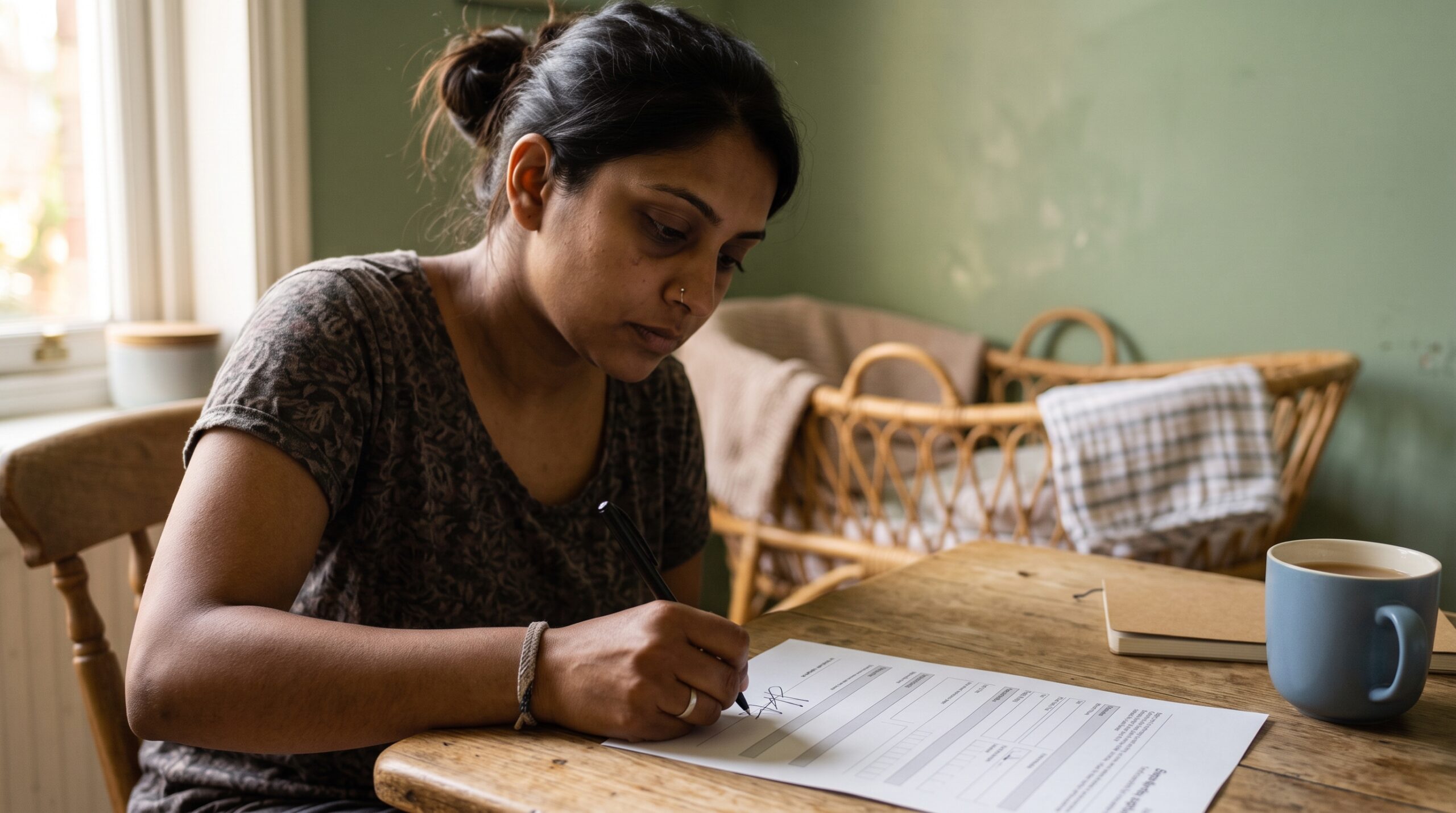
Meera’s newborn was six days old when a nurse mentioned WIC almost in passing. Meera had never applied for a benefit program before, had no idea her household’s roughly $38,000 income put her under the $40,034 cutoff for a family of two, and no idea the appointment itself would include a health screening, not just paperwork.
What the $40,034 line actually means for a household of two
WIC, the federal Special Supplemental Nutrition Program for Women, Infants, and Children, sets its income ceiling at 185% of the Federal Poverty Level (FPL), the U.S. Department of Health and Human Services (HHS) poverty measure used to set eligibility for dozens of federal programs, under 7 CFR § 246.7(d) of the Code of Federal Regulations (CFR). For the 2026-2027 guideline year, that works out to real dollar figures by household size.
| Household size | 100% FPL (annual) | 185% FPL, the WIC line (annual) |
|---|---|---|
| 1 | $15,960 | $29,526 |
| 2 (parent + newborn) | $21,640 | $40,034 |
| 3 | $27,320 | $50,542 |
| 4 | $33,000 | $61,050 |
Meera’s household of two, herself and her newborn, at roughly $38,000 a year, sits under the $40,034 line. If her income had instead been $45,000, she would have failed the straight income test, unless she qualified a different way.
The guideline is published as an annual figure, but most households are not paid annually. For a household of two, the same $40,034 line breaks down to $3,337 a month, $1,669 twice a month, $1,540 every two weeks, or $770 a week. Bring whichever pay stub matches how your employer actually pays you, and let the WIC office do the conversion rather than estimating it yourself.
The shortcut that skips the income paperwork entirely
Under 7 CFR § 246.7(d)(2)(vi), a household already certified for Medicaid, SNAP, or Temporary Assistance for Needy Families (TANF) is automatically treated as income-eligible for WIC. This is called adjunctive eligibility, and it applies whether the applicant personally receives one of those programs or is part of a family in which someone else does. No separate income documents are required at all, only proof of the other program’s enrollment, regardless of what the household’s actual earnings are.
The screening most first-time applicants don’t expect
Clearing the income line, or qualifying adjunctively, is not the end of the eligibility test. Under 7 CFR § 246.7(e), an applicant also has to be found “at nutritional risk” by a competent professional on the WIC clinic’s staff, through an actual medical or nutritional assessment, not a form. At minimum that includes height or length and weight measurements at the appointment, plus a blood test for anemia for most applicants over 9 months old.
The regulation is explicit that this finding is required to receive benefits, separate from and in addition to the income test. An income-eligible applicant who skips or fails this screening does not get certified.
How long the newborn and the parent each stay eligible
A non-breastfeeding parent’s own WIC certification runs through the last day of the sixth month after the baby’s birth, under 7 CFR § 246.7(g). A breastfeeding parent and the infant are both certified on roughly the same six-month cycle by default. States have the option, not the obligation, to extend a breastfeeding parent’s and an infant’s certification out to the child’s first birthday.

That distinction matters. The commonly repeated “WIC covers your baby until age one” claim is only guaranteed if your state has actually opted into the longer window. Ask the clinic directly which certification length applies where you live, and expect a recertification checkpoint around the six-month mark either way.
What to bring to the first appointment
Federal rules require proof of identity, for both the applicant and the infant, and proof of residency in the state, under 7 CFR § 246.7(c)(2)(i). Proof of income is required unless you qualify adjunctively through Medicaid, SNAP, or TANF. A Social Security number is not listed as a federal requirement for WIC, unlike SNAP, but local offices set their own intake specifics, so call ahead and ask exactly what identification they want for both you and your baby.
Bring documentation you may already be gathering for the newborn’s Social Security card or birth certificate, since hospital discharge paperwork is commonly accepted as identity proof for an infant this young. If your household is also navigating postpartum Medicaid coverage, confirming that enrollment first can simplify the WIC appointment through the adjunctive-eligibility shortcut above.
Frequently asked questions
Do I need a Social Security number for my baby to apply for WIC? Federal WIC rules do not list a Social Security number as a requirement, unlike SNAP. Local offices set their own intake specifics, so call ahead and ask exactly what identification they want you to bring for your baby and yourself.
My income is a little over the limit. Am I automatically denied? Not if your household already receives Medicaid, SNAP, or TANF. Enrollment in any of those programs satisfies WIC’s income test automatically, with no separate income documents required, regardless of your actual earnings.
I thought WIC just looks at income. What’s this nutritional risk screening? It is a required health and nutrition assessment by a professional at the WIC clinic, typically height and weight measurements plus a blood test for anemia. An applicant who clearly qualifies on income can still be turned down without a documented nutritional risk finding from that screening.
How long will my baby stay eligible? At minimum through the six-month mark, with recertification around that point. Some states extend infant and breastfeeding-parent eligibility to the child’s first birthday, but that is a state option, not a federal guarantee, so ask your local office which applies where you live.





Leave a Reply