
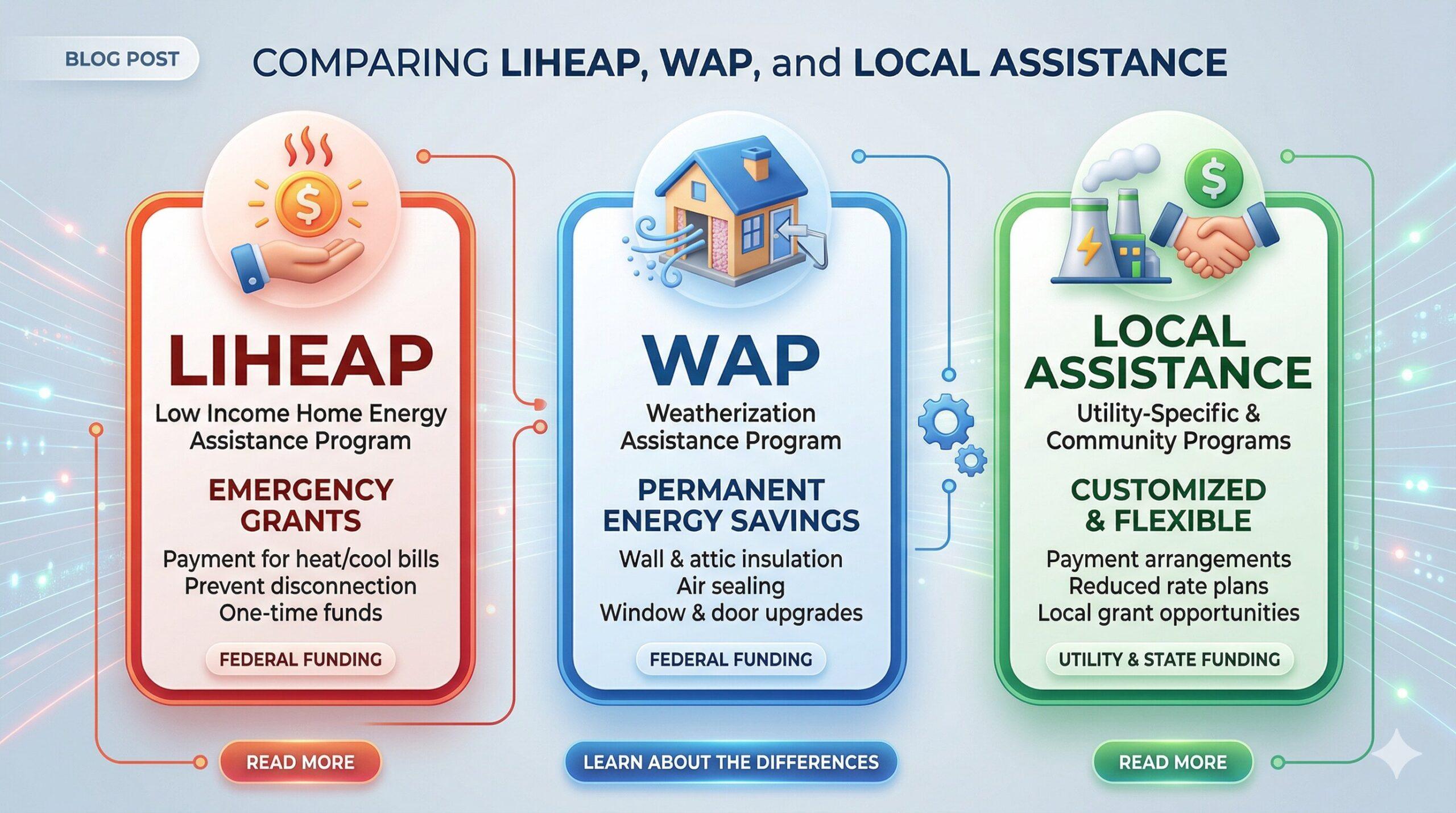
Marisol Etienne, 61, choosing between heating aid and weatherization in Lewiston, ME, has a narrow window after this event: has one cold-weather bill due now and a drafty house that keeps creating new bills.
The mistake is treating LIHEAP, weatherization, and local utility assistance like a general research project. In a real household crisis, the order matters. The first call should protect the thing that can be lost fastest. The second call should reduce the balance. The third should document the remaining gap. If you are still sorting out which of these categories applies to your bill, this breakdown of utility assistance programs walks through electric, gas, water, and more before you start calling.
Start with primary sources rather than marketing pages. For this topic, useful starting points include EnergyHelp LIHEAP locator, Energy Department weatherization program, USA.gov utility bill help. These pages do not replace a local eligibility decision, but they keep the first hour grounded in rules instead of search-result promises.
The first-hour triage
Write down the due date, the exact dollar amount, the agency or company name, and the consequence if nothing happens. That turns a vague emergency into a case file. It also helps a benefits worker or charity screener know whether this is a crisis request or a routine application.
Then separate three questions. First, what deadline can cause harm this week? Second, which program can legally help with that type of cost? Third, what proof will be required before anyone can approve money, coverage, or a hold?
Use one sheet of paper or one phone note. Put the crisis at the top in plain language: LIHEAP, weatherization, and local utility assistance. Under it, list the deadline, the balance, the household income change, and the best phone number for follow-up. This sounds basic, but it prevents the most common failure. People retell the whole story on every call and forget the exact date or amount when the worker asks.
The first office may not be the office that solves it. That is normal. Ask each worker two direct questions before hanging up. Ask, “Do you handle this exact cost?” Then ask, “If not, who handles it locally?” Write down the referral name, phone number, and any phrase the worker used. Those phrases often match the words on the next application.
| Program | Solves | Timing |
|---|---|---|
| LIHEAP | A current heating or cooling bill | Best for shutoff risk or arrears |
| Weatherization Assistance Program | Energy waste in the home | Slower, but lowers future bills |
| Utility hardship fund | Company-specific arrears | Often fastest when shutoff is pending |
| Local charity | Small remaining balance | Best after public aid amount is known |
A worked number to use on calls
Marisol's winter bill is $386. If LIHEAP pays $250, she still owes $136. Weatherization will not erase that balance, but it may lower next winter's bills after the crisis bill is stabilized.
That calculation is not just budgeting. It is the sentence to use when calling an agency: “The total problem is this amount, this source may cover this amount, and I need help with the remaining gap by this date.” Specific numbers make the request easier to route.
If the first estimate changes, update the math the same day. Do not let three different numbers float around. Agencies may deny or delay a request when the application says one balance, the utility portal says another, and the applicant gives a third amount by phone. The safest number is the current balance shown on the newest notice or portal screenshot.
Also separate the full debt from the amount needed to prevent harm. A household may owe $1,200 in total, but only $300 may be needed this week to stop a shutoff, keep coverage active, or preserve an appeal. That smaller action number is often the one a crisis program can work with.
What to gather before applying
- Photo identification for the adult applying.
- Proof of address, such as a lease, utility bill, or official letter.
- Recent income proof, including pay stubs, benefit letters, unemployment notices, or a written explanation of lost income.
- The bill, denial, notice, or account statement tied to the request.
- Any deadline notice, court date, shutoff date, enrollment window, or appeal date.
If one document is missing, apply anyway when the deadline is close. Put the missing item in writing and ask how to submit it later. A late perfect application can be worse than an on-time application with one clearly identified gap.
When uploading documents, use file names that make sense to a stranger. “Gas-bill-August-2026.pdf” is better than “IMG_4021.” If the portal allows notes, add one sentence explaining why the file is included. Workers handle many cases, and clear labels reduce avoidable back-and-forth.
Keep originals. Send copies when possible. If an office needs to see an original document, ask whether it can be reviewed in person and returned the same day. Losing a birth certificate, court notice, medical letter, or termination letter can create a second crisis while the first one is still open.
Common mistakes that slow approval
Do not start with paid lead forms, grant-advertising sites, or companies that promise special access. Public benefits and nonprofit hardship funds still require documents. A third-party form can cost time while the real deadline keeps moving.
Do not hide partial help already received. If one office pledges money, tell the next office the exact pledged amount. Many local programs are designed to fill a remaining gap, and a smaller verified gap can be easier to approve.
Do not rely on a phone promise alone. Ask for a confirmation number, email, portal screenshot, or letter. If the account later shows no hold or no application, that record is often the only way to get the case corrected.
Do not wait for shame to pass before making the call. Most programs are designed around documented disruption, not perfect past behavior. The worker usually needs facts, not a polished explanation. Say what changed, what is due, what has already been tried, and what date matters.
Do not assume a denial is final until you read the reason. Some denials mean the office needs one missing document. Some mean the wrong program was used. Some have appeal rights with a short clock. The denial reason tells you whether to fix, appeal, or reroute.
A practical 30-day sequence
On day one, stop the immediate loss. That may mean filing an appeal, asking for a payment hold, applying for coverage, or submitting a crisis-aid request. Do the time-sensitive step before researching every possible program.
By day seven, build the paper trail. Save screenshots, letters, account notes, and names of people spoken to. If a caseworker gives a document list, copy it into a checklist and mark each item as submitted, pending, or unavailable.
By day thirty, decide whether the first fix solved the underlying problem or only bought time. If the bill, coverage gap, or caregiving cost will repeat, move from crisis aid to a longer-term program before the next notice arrives.
The goal is not to apply everywhere. The goal is to apply in the right order, with the right proof, before the deadline that would make recovery harder. That is how a household turns a messy emergency into a sequence of solvable steps.
What to say when you call
Use a short script. “My name is Marisol Etienne. I live in Lewiston, ME. I am calling about LIHEAP, weatherization, and local utility assistance. The deadline is on my notice, the amount is written down, and I can send proof today. Can your office help with this exact issue, or should I call a different office first?”
That script does three useful things. It keeps the call focused, tells the worker the case is time-sensitive, and invites a referral if the office is wrong. It also avoids a long story before the worker knows whether the program can act.
After the call, write a three-line note: who answered, what they said to do next, and what deadline they gave. If they said no, write the reason. A clean denial reason is still useful, because it tells the next office what problem remains unsolved.
If the next step is unclear, ask for the application name, not just the agency name. Large agencies often run several programs from the same front desk, and the wrong form can cost several days.
For Marisol, the next move is simple: make the deadline visible, verify the primary source, submit the strongest application first, and keep a written record. The rest of the work gets easier once the immediate loss is paused.





Leave a Reply